

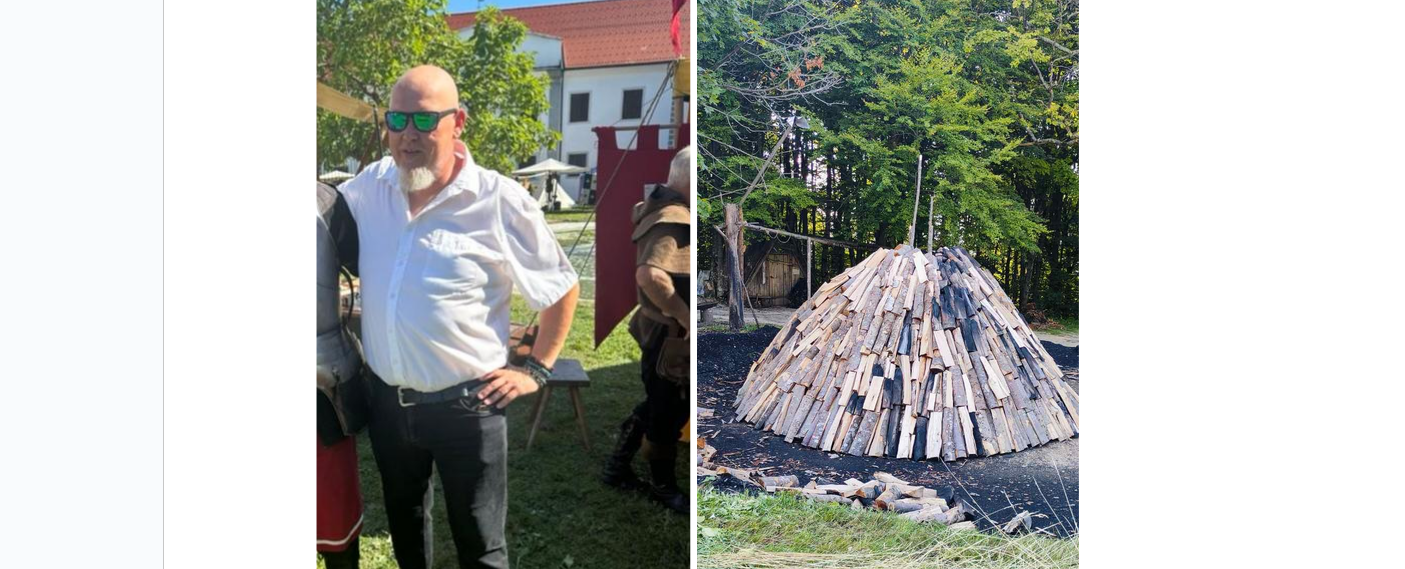
On the western edge of the plateau is a charcoal heap - a place for a charcoal mine. This traditional economic activity, which for centuries had its centre in the forests of the Gorjance Mountains, is kept alive today by members of the Gorjanske košenice Association, who demonstrate the process of cooking charcoal every year (probably in September). The charcoal is then stored and put into neat packaging bearing the Miklavško oglje brand.
Preparations always take place some time before the event. This year, some of them started as early as July and August. Other fans can also help. So Mitja came to help this year too.
In Gorjanyany, charcoal is produced by the traditional process of burning wood in fire pits - kopa. The wood is piled in a conical pile, covered with soil, grass, spruce branches and ferns and slowly burnt over several days in a controlled air flow. Holes are also made in the covered mixture to allow air to enter and smoke to escape. During the slow smouldering process, the gases and moisture are thus extracted from the wood, leaving the charcoal. The process requires a great deal of skill and precise control of temperature and air to ensure that the wood does not burn to ash. In the past (and in some places even now) charcoal was cooked in this way.
The pile is mostly made of hazel, which is the best wood for charcoal, but otherwise hardwoods (beech, hornbeam, maple) were used. The pile is lit on the first Saturday in September and burns for about two weeks, during which time the members of the association carefully supervise the charcoal cooking night and day.
The charcoal is cooked at 250-280 degrees Celsius. The colour of the escaping smoke is an indication of when the charcoal is cooked. In dry weather, the pile is broken up and cooled. Once broken up, the pile yields around 1 500 kg of first-class charcoal. Although they sell some of the charcoal, it is not about making money, but about preserving an old, almost forgotten trade and knowledge and passing it on to the younger generation.
Every year, 600 to 700 schoolchildren come to visit the pile and listen to explanations about charcoal burning, forests and the importance of ecology during the Natural History Days.
Andreja Bakšič Grozdina, 27 Aug 2025
 English (UK)
  Slovenščina
  Italiano
  Magyar