

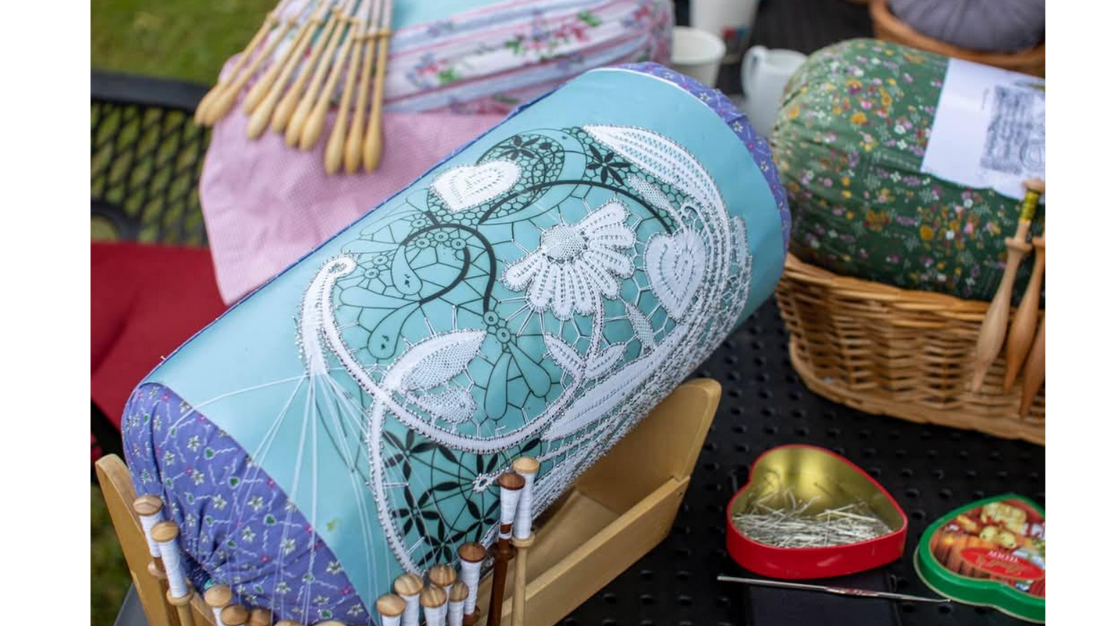
This unique human craft is present across various Slovenian regions, represents a connecting thread between the older and younger generations, and is also considered an important part of our cultural heritage.
Slovenians can be proud that since 2018, lace-making in Slovenia has been included on the UNESCO List of Intangible Cultural Heritage, with the active participation of the women of Koroška, who have been working to keep this special creative skill alive over time.
Organised lacemaking has been taking place in Carinthia for 35 years. It blossomed thanks to Marija Apohal, who learned this master craft and later selflessly began passing it on to her students. Since then, for those who engage in it, lacemaking has become not only a soul-enriching creative pursuit but also a way of connecting with each other, fostering new friendships.
Mira Časar, President of the Koroška Association of Women Knitters, said that over the years, a special bond and sense of belonging had been forged among the women knitters. This is not only true for the members of the association, as several times a year, individuals from all over Slovenia come together to knit. Among other things, they also meet every October at the Ljubljana Lace Festival for a group knitting session.
Mrs. Mira, who is a retired history and geography teacher, revealed during our meeting that she also passes on such skills and knowledge to younger generations. She selflessly passes on her knowledge as a volunteer. Among other things, she runs a club at Šentjanž primary school near Dravograd. She says that bobbin lacemaking has a beneficial effect on children, as this activity helps them to develop manual skills and practice patience, and it also strengthens their sense of belonging to a group.
Many children who engage in bobbin lacemaking develop a respect for manual work, which can be useful to them in many other areas. During our conversation, Ms. Mira recalled an event that happened to the first generation of children learning this skill. For the purposes of running the workshop, they bought bobbins shaped like rugby balls, and the children ripped one of them, so they had to buy a new one, which wasn't cheap. Thus, they learned not to just throw the bobbin lacemaking bobbins around.
»When the children started bobbin lace making, they developed a greater respect for this work, as they saw how much time and energy had to be invested for something to be created,« says Mrs Mira. She adds: »After that, a bobbin lace could lie on a bench, in the dining room or anywhere else, and nobody would touch it, because they had changed their view of bobbin lace making. They began to respect this skill.«
To conclude, she mentioned that one of the children she teaches, who was initially very restless, eventually developed patience through bobbin lace making. He also started helping other children. Many might not consider it, but bobbin lace making is much more than just cultural heritage; it also enriches people's personalities.
Mateja Sekavčnik, 24 March 2026
 English (UK)
  Slovenščina
  Italiano
  Magyar