

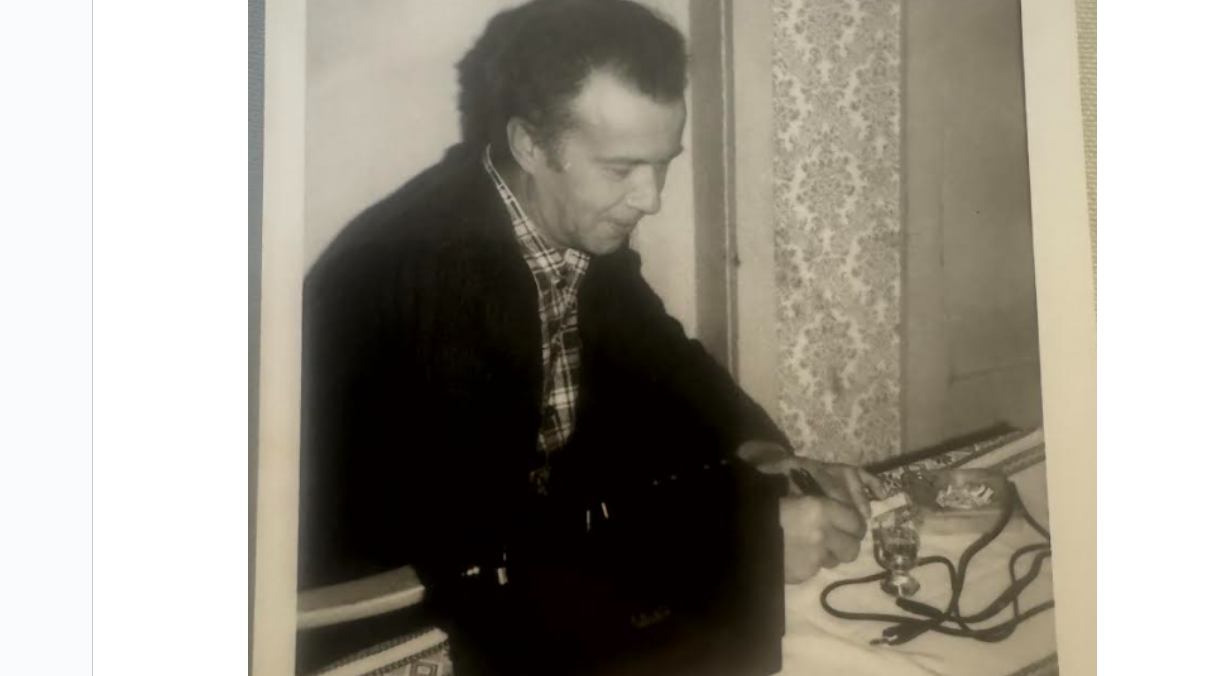
Slow in words, but quick in good deeds. One of those who never sought praise, but would be worthy of it every day.
He lived simply because that is what he was - without great desires, without haste. He was born in Špitalič near Slovenske Konjice, in the immediate vicinity of the Žička Carthage. Among the hills and humble people, where one worked with one's hands and spoke little. People at that time believed more in the power of work than in the power of words. It was his mother who first showed him the sewing machine. »Don't be ashamed of work, be ashamed of laziness,« she told him. And that is what was imprinted on his soul.
He and his wife Ruža moved to Slovenske Konjice when they had their first child. »It will be better for the boy in Konjice,« he said. He got a job in Konus, where he was known as a reliable worker. He was never short of words, but never short of them. He thought and answered quite judiciously. If you asked him how it was, his answer was always the same: »Ah, it's going as it should.«
But what set him apart from the others was not to be seen in the factory, but at home - at that old sewing machine in the corner of the living room. That was his world. It was where he took refuge after work, when Ruža was cooking dinner and the children were watching TV. He was not sewing for himself, not for sale. He sewed for people whom life had forgotten.
If he heard that a neighbour was going through a hard time, that someone was left without a coat, or that a single mother couldn't buy a jacket for her child, he went to buy a metre of cloth. He didn't question, he didn't judge, and he didn't judge. He just sat back, put his foot down and let the needle do the talking.
"It doesn't take much to make a difference,« he said. »Just time and a little heart for a fellow human being in need."
Every Christmas was special for him, and not because of the kitsch of a materialistic world. He didn't decorate his flat, he didn't light the lights and he didn't buy presents. He spent Christmas in front of his sewing machine. He always had patterns cut out, scissors, fabric in a few warm colours and a slip of paper with names on it. The people whose names were written there did not know about it. This was his list of good souls, as his wife Ruža called him.
When I was a little girl, I used to see him leave the block with two bags the evening before the holidays. One was for Karitas and the other was for someone he knew. I understood in that moment that sometimes the greatest people work in silence.
One year, he made a coat for a man who lived in an old garage near the bus station. Nobody had ordered it for him, nobody had asked him for it. He just said, »If God remembers him with cold, let me remember him with a little warmth.«
That was Slavko - he didn't have much, but he could give like a king.
When he got sick, the machine stopped. For the first time in all these years. Every night before he went to bed, Ruža said, he would run his fingers over the sewing machine as if he wanted to touch it again. When she took him to the cellar of the block, she said that now he was there like a the quietest proof that goodness doesn't rust.
When I walk past the block of flats on Škalska Street, where I no longer live, I sometimes think I hear that familiar, calm sound: so-so-so-so. Like the beating heart of a man who understood that heat does not come from radiators, but from hands that cannot stay still.
Mr Slavko Klokočovnik was a Konjian at heart and soul, and a miraculous tailor of warmth with his hands. His clothes warmed bodies and his gestures warmed people. And if there were a thread that linked good people together, it would surely be recognised in his stitching - even, quiet and firm, as he was himself, despite his unwavering modesty.
Zala Krupljan, 18. 10. 2025
 English (UK)
  Slovenščina
  Italiano
  Magyar