

1. Activity title: Ice bridge
2. Target group
- Pupils in years 1-5 of primary school (adaptable for pre-school).
- Estimated duration: 1 to 2 school hours
3. Form of work
Classroom work, individual work, group activity, discussion
4. Didactic starting points
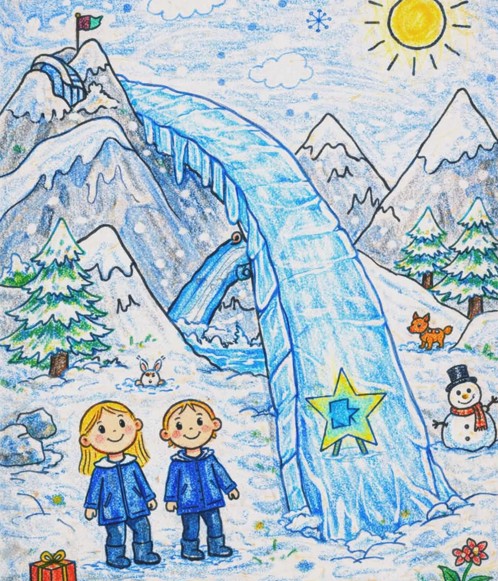
The activity is based on the understanding that an ice bridge represents something fragile and slippery. Trust between people is also like that. Honesty is what makes the bridge stronger, allowing us to navigate through difficult relationships and build a sense of security. Without honesty, the bridge can collapse. Honesty is a prerequisite for trust, and together they are the foundations for building relationships.
5. Learning objectives
- Recognise that telling the truth is sometimes difficult
- overcome the fear of judgment
- To understand the value and importance of trust
- to take responsibility for one's own actions
6. Accessories
- large cardboard
- Rectangles of white paper (stone-shaped)
- flomaster
- Glue
7. Course of Activities
The teacher reads the fifth page and leads a discussion.
Interview questions
- Here's the translation: Why is it sometimes difficult to be honest and truthful?
- Have you ever cheated to win a game, or lied to get out of trouble?
- Why is it important to always choose honesty and integrity (even if they don't lead to victory at that moment)?
8. Art activity: Bridge of trust
Objective Visually depict that honesty builds trust.
Flow:
- On cardboard, we draw two banks, with a river between them.
- Let's explain that to cross a river, from one bank to the other, we need a bridge.
- Each child gets their own »stone« from white/grey paper.
- Napiše in/ali nariše eno besedo, povezano z iskrenostjo (npr. RESNICA, POGUM, ODGOVORNOST, ZAUPANJE …).
- The stones are glued together to form a bridge.
- Under the bridge we can write: We build trust with honesty.
9. Physical activity: Crossing the bridge
Objective To experience the courage to speak the truth in a safe environment.
Flow:
- Let's prepare a line, 3–4 metres long (you can use coloured masking tape, draw with chalk, etc.)
- We explain to the students that this is an ice bridge that can only be crossed with honesty.
- Pupils line up in front of the bridge.
- Each of them must tell one truth about themselves before crossing (which isn't necessarily personal or sensitive in nature). Example truth:
- Sometimes I get angry.
- Yesterday I forgot my homework/notebook.
- I didn't tell my mum the truth straight away.
- I ate my brother's whole chocolate bar...
- After speaking, they slowly cross the bridge (along the line).
- The group listens in silence.
- Upgrade option: the bridge can be built from hoops that are placed on the ground and jumped through; they can do a forward roll on a mat... (we can adapt the method of movement as desired). We can add that the group applauds each person for their courage when they are sincere.
- Important rule: no comments or mockery.
10. Conclusion and reflection
Final thought: »Truth builds trust.«
Let's talk about why it's important to be honest and what happens to trust if we aren't. Pupils can reflect on and share their experiences with honesty (or lack thereof) and its consequences. Let's steer the conversation towards a discussion about why truth requires courage and why it's important to be honest, even when it's difficult.
Primary School Piran
 English (UK)
  Slovenščina
  Italiano
  Magyar