

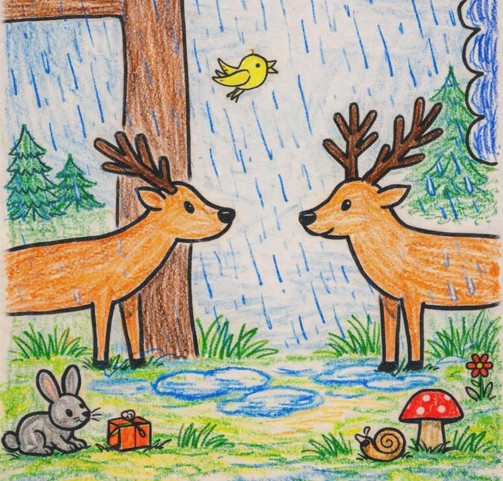
1. Activity title: Quiet forest
2. Target group
- Pupils in years 1-5 of primary school (adaptable for pre-school).
- Estimated duration: 1 to 2 school hours
3. Form of work
Classroom work, individual work, group activity, discussion
4. Didactic starting points
The activity is based on the understanding that the Quiet Forest represents listening, attentiveness, self-control, and caring for others. Respect means not only not harming others, but also knowing how to wait, listen attentively to each other, and observe. We must be respectful of everyone and everything around us.
self.
5. Learning objectives
- developing self-control
- active listening training
- understanding respect as a concrete action and the awareness that respect and trust go hand in hand
6. Accessories
- poster
- wooden leaves of paper
- flomaster
7. Course of Activities
The teacher reads the fourth page and leads a discussion.
Interview questions
- How do you imagine the Quiet Forest?
- It is important for children to behave respectfully towards animals, nature, and each other
- When do you show respect?
8. Art activity: The Tree of Respect
Objective Visually depict respectful behaviour.
Flow:
- We draw a large tree without leaves.
- Every child gets one sheet.
- Where is the act of respect written or drawn.
- List of fasteners on the tree.
- Conversation topic: A tree only grows if it is cared for. We must also care for our tree of respect so that it always grows more new, beautiful leaves. Respect also allows us to grow. Pupils present written/drawn acts of respect.
9. Movement activity: Silent Forest
Objective To physically experience the meaning of respectful behaviour.
Flow:
- The children move slowly around the room (we choose the mode of movement ourselves).
- When the teacher says "FOREST," everyone stops, they are completely still and listen in silence for 5 seconds.
- When the teacher says WIND, they move again, mime the wind with their hands, they can rustle like the wind.
- When the teacher says "RESPECT", approach the nearest classmate, shake their hand, and smile at them.
- Customisation option: we can add more instructions, different movements and tasks.
10. Conclusion and reflection
Final thought: »Respect helps our forest grow and flourish.
«Not all of us feel well."
Let's discuss what examples of respect were written/drawn on the respect tree, when they might have been disrespectful, how we show respect in the classroom, why respect and trust are important. We can also link the discussion to the silence game – was it difficult, what happens if we talk over each other… Let's emphasize the importance of respect in the classroom, as it is a value that allows us to grow together.
Primary School Piran
 English (UK)
  Slovenščina
  Italiano
  Magyar