

We have decided to systematically develop the 5 core values of Slovenia throughout the entire school year. As we wanted to dedicate sufficient time to each value and address it across the whole school, we are carrying out the activities as part of the extended programme (RaP). This lesson, named Klik – Together we can, is incorporated into the regular timetable (not before the start or after the end of classes) and includes all pupils. It is timetabled to alternate weekly with the class lesson within the same time slot. The purpose of the content addressed during this lesson is primarily to strengthen pupils' social and emotional skills, as these are a key factor in the development of mental health, and also help to build a supportive, safe, and inclusive school environment. They also indirectly contribute to better learning outcomes for pupils. The lesson is usually led by the form tutor and a co-tutor, as the activities are typically carried out in the form of workshops and involve a lot of discussion and group work. The presence of two teachers allows for better support for pupils and a more dynamic execution of activities.
We allocate two school hours to each value. We prepare various activities tailored to the pupils' age on the topic of each individual value. The workshops are designed so that all teachers can carry them out, regardless of their professional background or experience in this kind of work. For these purposes, we presented the project in more detail to the teaching staff at the beginning of the school year, explaining how we work, and additionally, we gave teachers appropriate guidance and ideas for carrying out the workshops. We also use materials and suggested activities created within the project to help us plan the activities. We strive to make the activities diverse, inclusive, and to encourage pupils to think critically and participate actively.
TRUST AND RESPECT
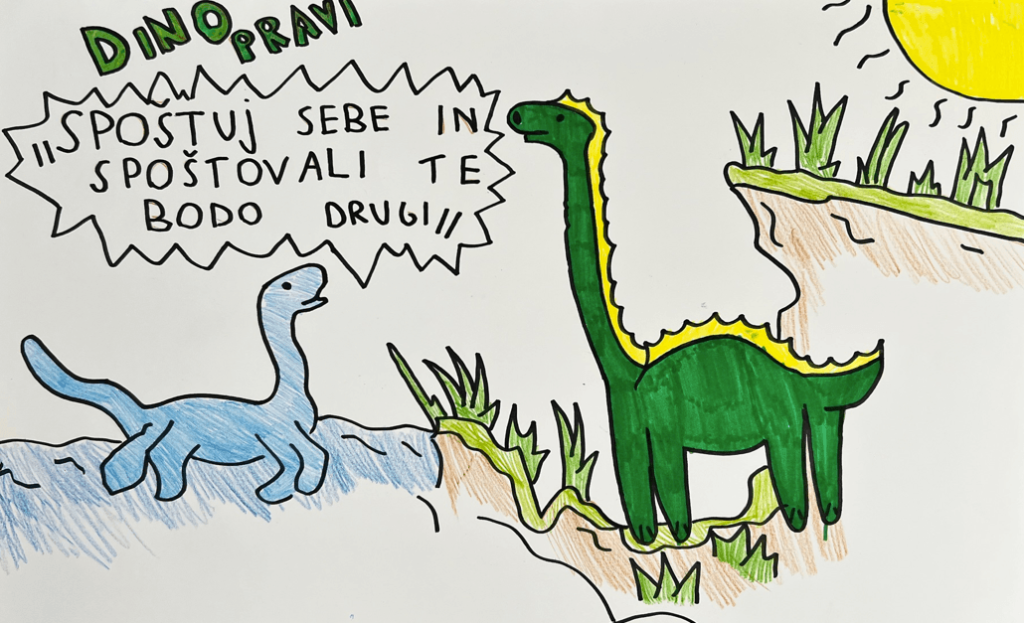
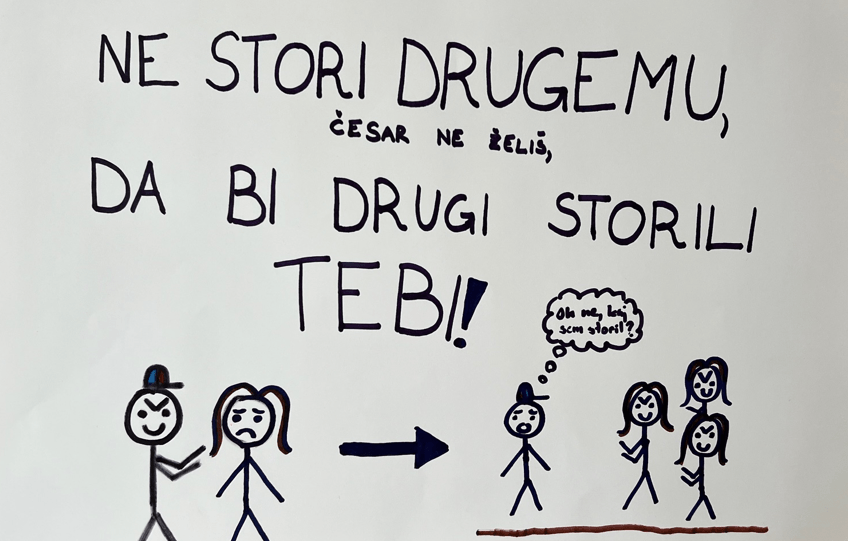
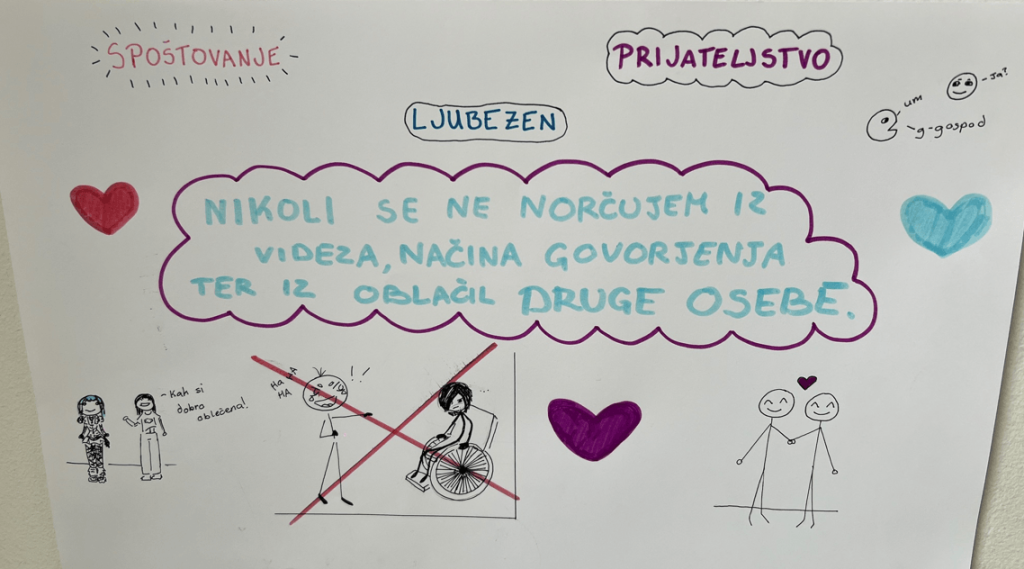
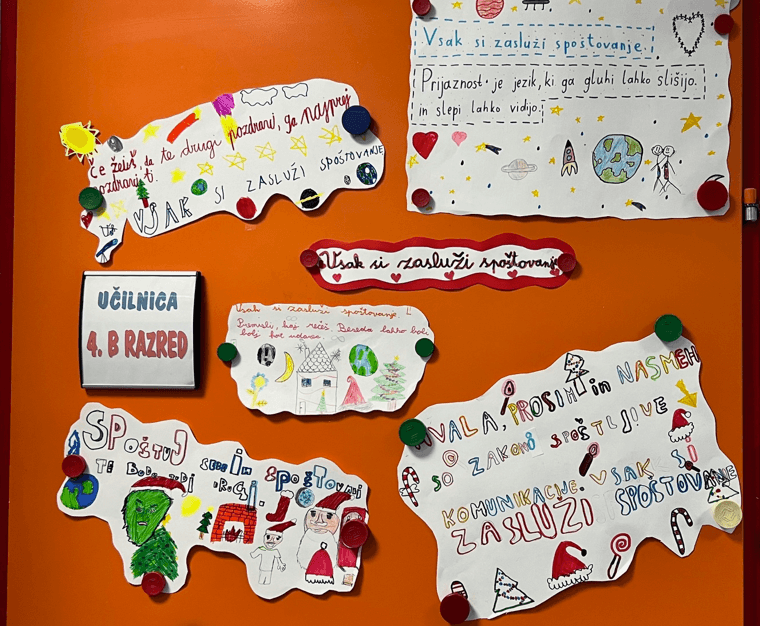
We carried out an activity called "Respect Overwhelms the School", during which pupils reflected on the importance of respect and prepared posters on this theme. These were then displayed around the school, reminding us at every turn of the value we devoted special attention to during a certain period.
URA
VEHICLE 1. On the board, write the title of the first set of values and ask the students why they think these two values are paired. A discussion on this topic will follow.
Mutual trust and respect are fundamental values that appear in a relationship. They are like two sides of the same coin. Both values pertain to the relationship. The latter cannot exist if neither is present. Trust allows us to open up to others and believe in their goodwill, while respect ensures that we treat others as (equally) worthy. Without trust, there is no respect, and without respect, there is no trust. What do we imagine when we talk about a relationship? It can be a relationship between me and another person, between me and society, or between me and the company where I work, or the school where I study. Trust is more of an emotional value, as it allows us to open up to others and believe in their goodwill. Respect is more of a rational value, as it involves recognising the dignity, rights, and achievements of others, regardless of feelings.
VAJA 2. Ask the students if respect and reverence can be equated. Discuss this.
Respect and politeness cannot be equated. Respect is, in fact, a value, while politeness is a skill. A value is a fundamental belief that determines what is important to us and in our society. We cherish it and believe it to be good for both ourselves and society. A value serves as a compass throughout our lives, guiding us in our actions and decision-making. Based on this, we know what is right. When we act in accordance with true values, we will not regret our actions and decisions, and we will remember them with pride even in old age. A skill is an ability that we can acquire, just as we can learn to drive a car, for example, while politeness is something we must learn. From a young age, we learn expressions such as »please« and »thank you,« we learn good behaviour towards the elderly, and later in life, also courtesy towards others.
Simply put:
- We carry respect in our hearts.
- Skill (respectfulness) is acquired so that we are outwardly polite to others.
VAJA 3. Pupils should express their opinions on the negative consequences of disrespect.
Disrespect has numerous negative consequences for both the individual and society. Some of these include:
- The feeling that you know everything and therefore don't need to listen to others leads to self-isolation and disputes with those who think differently.
- If I immediately dismiss the opinions of those I don't respect, without considering whether there's anything good to be gleaned from an opinion that differs from my own, I am hindering my own progress, as others, who are more open to differing opinions, will surpass me in development.
- A group of people, among whom mutual respect prevails, achieves better results faster than a group in which even one individual who does not respect others can significantly spoil the work. The latter can be reflected in poorer results for the entire team.
- Disrespect for others can quickly escalate to contempt, and soon thereafter to intolerance and hatred towards those who think differently.
Mutual respect builds society, while disrespect damages the bonds between its members.
VAJA 4. We will do the Respect (or lack of) Cards exercise
Names: Children illustrate different forms of respect and disrespect, then evaluate and discuss each one. This broadens their understanding of respect.
Procedure: On a card, we write ten forms of respect and ten forms of disrespect:
- The family sits together at the table, its members listening to each other.
- The child listens to their friend when they speak.
- The pupil listens to the teacher and raises his hand when he wants to say something.
- In the library, the children read quietly so as not to disturb others.
- A student raises his hand in class before speaking.
- When the little girl drops a wrapper on the floor, she picks it up.
- A boy on a bus gives up his seat to an elderly lady.
- Children follow the rules during play and do not change them as they see fit.
- Before the pupil borrows the crayons, they ask for permission.
- While his friend is talking, the child turns away and doesn't listen.
- The boy is shouting at his classmate.
- Two girls exclude a third girl from the game.
- While the child sits with the family at the table, they look at their phone and ignore everyone else.
- The student doesn't want to lend their textbook to their classmate.
- A group of children are mocking a classmate because of the clothes they are wearing.
- Someone throws a friend's notebook on the floor.
- The boy pushes the girl away from the swing.
- The child is showing signs of boredom during the conversation and is yawning.
- A group of children whisper and carry out another classmate.
Each pupil receives a card and a sheet of paper. On one side of the card they draw a specific form of (dis)respect, and on the other side they write text. Each pupil shows their drawing, and the others try to figure out which form of (dis)respect it is.
If they don't figure it out after a few tries, the learner helps them with an association or an additional
description. Once they have figured out what it is, they create the opposite of what is described on the card, and discuss how to express the given form of respect.
If you think pupils won't want to draw, they can just write a description of a specific form of respect or disrespect on the sheet, or illustrate it through mime.
URA
Task 1. We'll talk to the pupils about trust (5–10 min).
Students are asked questions such as: »What does it mean to trust someone?«, »Who
Can you be trusted? What characterises a person who is trustworthy? What do you do when
Has someone betrayed your trust?«
You can use the text to help you with your conversation:
Trust is fundamental to life. Without basic trust, we cannot live at all. An individual's trust in another person or institution is built and grows. A baby in the first days and weeks after birth needs an immediate response from its mother. Over time, it realises that mother is nearby and will return soon. Thus, trust is built gradually – step by step. With trust always comes a certain amount of risk. A child trusts that their father will always catch them when he throws them in the air. The father must start with low throws, gradually increasing the height. The father's task is also to judge what is still safe and how to give the child a sense of security. A community based on mutual trust is more successful. Mutual trust is reflected in the belief that others are trustworthy and will act in accordance with agreed norms, values, and expectations. This creates a sense of security and the belief that others will not abuse this trust, but will act honestly, responsibly, and reliably. Mutual trust does not mean unconditional trust in everyone, as a person who acts contrary to values cannot be trusted. Mutual trust is easier to build in a community in which we trust strangers on first contact, while with each subsequent contact, trust is built if the person proves to be trustworthy.
Task 2. Let's play a trust game (5-10 mins).
The purpose ofThrough play, we offer children an experience of risk-taking, where a leap into the unknown ends in a safe embrace. To establish trust, we must always venture into the unknown, with trust being paramount. Therefore, a child needs an experience of risk that ends happily. Through games in a safe environment, we can offer them this experience.
AccessoriesDo you need a tie or scarf to blindfold (for the blind lead game)?
You need more of them.
FlowThe pupils are divided into two groups. Each group also has a teacher who can participate in the game too. The pupils are clearly told that although this is a game, the given rules must be followed responsibly and consistently. These games involve risk, and every participant must be sure that others will act very responsibly.
- Trust Fall: One of the pupils has their eyes blindfolded, while the others stand around them close enough to each other. The blindfolded pupil in the middle falls backwards, and those surrounding them catch and gently push them towards other pupils in the circle.
- Leading the blind: Pupils are divided into pairs, with one of the pupils always blindfolded. The game leader (teacher) walks around (can also be around the school), and the pupils in pairs follow him. The leader chooses a path that is sufficiently challenging and full of obstacles, and the sighted pupil safely guides their blind partner along the intended path, being able to direct them only with their hands and instructions.
Task 3: Respect fills the school
The purpose ofThe class is designing posters on the theme of respect. Stick one poster on the door of their classroom (where the gratitude board used to be), and hang the others in the classroom and around the school. The goal of the activity is for respect to permeate the school and for us to be reminded of this value at every turn. Through the design of informative posters, we encourage reflection, conversation, and actions related to respect.
AccessoriesA4 and A3 sheets
FlowWe divide the pupils into groups of four or five. Each group receives its own poster, on which the pupils write their thought, and if they wish, they can also illustrate it. While they are creating, we talk with them about what this thought means and how they should express it in the classroom, school, at home, etc.
The frame contains a collection of thoughts about respect. You can add your own to them or encourage the learners to do so.
- »Thank you«, »please«, and a smile are the laws of respectful communication.
- Everyone deserves respect.
- Monkeys, chickens and pigs are animals that are not at our school. Here we have pupils, teachers, and other colleagues, who have their own first and last names.
- »Kindness is the language which the deaf can hear and the blind can see.
- Nobody should mock someone else's misfortune or trouble.
- If someone confides in me, I can only pass it on if I have their permission to do so.
- Think before you speak. Words can hurt more than a blow.
- Do not do to others what you would not want done to you.
- A sincere apology, offered as soon as we realise we've made a mistake, is an expression of respect.
- If you want others to greet you, greet them first.
- »Respect yourself, and others will respect you.« (Confucius)
- Mistakes are part of learning and should not be a cause for insult.
- »People will forget what you said and what you did, but people will never forget how you made them feel.« (Maya Angelou)
- We resolve disagreements with conversation, not insults.
- Small acts of kindness say more than big, strong words.
- We never make fun of how another person looks or how they speak and move, nor do we make fun of the clothes they wear.
Honesty
We discussed honesty through various stories, through which we encouraged students to reflect on their own behaviour and ethical dilemmas in everyday life. Through discussions, students exchanged their views and experiences and reflected on the consequences.
of various decisions.
URA
VEHICLE 1. Instead of an introductory discussion, divide the pupils into groups of four. Give each group a sheet of paper (15–20 minutes).
We ask the pupils a question: What is fairness and how would you describe a fair person?
They are thinking and talking about this question. In the end, they write the definition on a piece of paper.
honesty and a description of an honest person.
Each group will present their recording.
If you have enough space in your classroom, write 'honesty' on a piece of paper and stick/hang the group sheets around it.
A note that can be helpful during a conversation about honesty:
Honesty is conditioned by sincerity, fairness, and truth, and is expressed through an individual's conduct. An honest person is sincere with themselves and others, does not lie, steal, or deceive. Furthermore, they are trustworthy and impartial, do not harm others, are responsible, and have the courage to do what is right. Honesty is a key value of a successful society, as it builds self-confidence, creates positive relationships, and contributes to a sense of security and justice. Therefore, it is important to strive for honest conduct in all areas of life, and also to encourage honesty in others. Members of a society where honesty prevails feel much more relaxed and free, and thus such a society can also progress much faster.
VAJA 2. Based on the story, let's start a conversation (one story is available for 4th-5th grade, and another for 6th-9th grade).
The purpose ofThrough a story-based discussion, children connect the elements of fairness they find in it with their everyday lives.
FlowTogether with the pupils, read the story. The pupils can remain in their originally formed groups. Distribute questions to them, which they can print along with the story. Let them discuss the answers within their groups and express their opinions. Finally, each group should report on their findings.
Story for 4th–5th Grade: Fairness dinner
When my sister Vanja turned twelve, she had to pay more for the bus ride than before. However, the next time she got on the bus, the driver charged her the cheaper fare again. Vanja was shy and didn't dare to say anything, even though she thought: »I am now twelve. He should be charging me more.« At home, she asked her dad what he would do in her shoes. Her dad replied: »You have to decide for yourself. You could probably pay less for a while longer without anyone noticing.« He patted her on the shoulder and added: »The transport company probably won't go bankrupt because of this small change. Still, I don't know if it's worth selling your integrity so cheaply.« The next time my sister got on the bus, she handed the driver the difference he had given her back the previous day along with the money for the more expensive ticket. That was many years ago, and her father had since died. Recently, I took half of my monthly salary to the bank to put it into my account. I handed the clerk at the counter the money in an envelope. She credited the sum to my account and also returned the same amount to me in cash. Now I had half my salary in my hand and the same amount in my account. The woman at the counter had mistakenly doubled my money! But I heard my father's words in my mind and thought: »No, Dad, I won't sell my integrity either, not for a small change and not for half my salary,« and I returned the money.
- Let's talk.
- Have you experienced anything similar before? How did you handle it?
- When do you find it difficult to be honest? What do you do then?
- If you've ever decided to act in a way that was more advantageous at the time, but dishonest, how did you feel afterwards? Why? (Humans have an inner voice – conscience. If you do something dishonest, it gnaws at you, you can't sleep peacefully, you can't be content.)
- Do you know anyone who is truly honest?
- How does this person live and work?
Story for 6th–9th Grade: Honest scholar
An elderly teacher, on his deathbed, wanted to find someone worthy of his daughter's hand. All his students vied for this beautiful young woman, so the wise man decided to set them a test. He gathered them around him and said, »I am old and weak now; I can no longer feed myself and my daughter. I now entrust this task to you. Are you prepared to take it on?« »Yes, master, with all our hearts!« the students cried. »Just tell us what we must do.« »I shall tell you. You will get little from begging, so you will have to find another way. You must agree to steal and rob for your old teacher.« The students looked at each other and replied, »We would do anything for our teacher.« »Very well,« said the teacher. »I shall test you. Go out into the world and try to amass as much wealth as you can. Be resourceful – lie, steal, cheat, give false testimony. Become highwaymen and burglars. You must not hurt or kill anyone, however. To him who returns with the greatest wealth, I shall give my daughter in marriage.« The students jumped up in excitement. They began to discuss where each should go. Some decided on the roads, others on the streets, some on villages, others on wealthy estates. They made plans and advised each other on how and what to do. They were ready to set off that very moment. Only one student stood aside, silent and sad. He loved the teacher's daughter more than all the others. The teacher asked him,
»What is wrong with you? Don't you want to compete for my daughter's hand?« »Respected teacher, I love your daughter more than anything in the world. I would walk through the Himalayas for her, I would swim across the ocean. I could die for her. Yet, even for her, I could not do something dishonourable. Forgive me, teacher, but I will not go into the world to steal and rob, because you taught me otherwise!« When the teacher heard this, he stood up and hugged the young man. »You are my only true disciple. My daughter will be your wife.« When the others saw this, they bowed their heads in shame. From then on, they were no longer tempted to do anything dishonourable.
- Let's talk.
- What was the old teacher's intention with his students?
- Why do you think most students failed to see that the teacher's proposal contradicted his previous teachings? (Their desires, feelings, and personal interests outweighed their reason, conscience, and awareness.)
- He didn't really ask for any material wealth, money, gold. What did he ask for? (Honesty. That they know right from wrong, even when tempted.)
- Your honesty will have been tested before too. Do you remember any examples?
- Do you know anyone who is truly honest?
- How does this person live and work?
URA
VEHICLE 1. Fairness from an accountability perspective
Names: Through discussion related to the story, children connect the elements of honesty they find in it with their everyday lives.
Talking through a story
Pupils were playing football in the school yard when Niko accidentally smashed a classroom window with a ball. At first he wanted to run away for fear of punishment, but he knew he had to take responsibility. He reported to the teacher and said: "I broke the window, I'm sorry. I'll help you fix it." Together with his father, he paid for a new window and the class organised a collection of old bottles to cover part of the cost. Niko also cleaned up the glass so that no one would get hurt. His responsibility prevented harm to others and showed that honesty means righting wrongs. The teacher and classmates appreciated Niko's action and the class became more cohesive. If Niko had denied guilt or left a broken window, it would have caused mistrust and danger. Responsibility brought respect and security, while irresponsibility would have led to distress and fragmentation.
Interview questions:
- What choices did Niko have after he broke the window? Guess or predict how the story might have gone with different possible choices.
- Give an example of a time when you yourself acted responsibly in a similar situation. How did it make you feel? How did other people react?
- What are you responsible for? How do you exercise this responsibility?
Let's introduce some proverbs and discuss their meaning:
- "Fairness doesn't need rules." Albert Camus
- "Honesty is the first chapter in the book of wisdom." Thomas Jefferson
- "Honesty is the way to achieve the most." Slovenian proverb
Let's introduce some proverbs and discuss their meaning:
- What is the advantage of being honest?
- What can the results of your honest actions do for you, your family?
- Who do you know who is really honest?
Fairness from an accountability perspective Taking responsibility for one's actions, rectifying mistakes, and avoiding harm to others.
VAJA 2. The lie and the truth
"Honesty is often the boldest form of courage." William Somerset Maugham
The media's image of the world, which includes marketing and political marketing, is often distorted. This image shows ideal things that cannot be achieved in real life, or unreal things that cannot exist. Children and adults are misled by this media image and often they too start to imagine ideal or unreal things as if they were real and as if they were happening to them.
Purpose: Pupils will learn about examples of lies and truths and deepen their understanding of these concepts by searching for these examples in everyday life.
Flow:
Let's make a simple table and start talking and adding simple examples, such as the table below.
| The Truth | A lie |
| Or it's blue. A dog has 4 legs. Our school is called _____________. | The grass is blue. Apples are made in a factory. Our teacher's name is Micka. |
Please ask the children to list a few more false and true statements. Adapt the table to the age of the pupils.
When they have completed the table, we ask them what the difference is between a lie and the truth, and discuss their answers.
We can broaden this by watching some adverts on television. It makes sense for the teacher to choose some adverts that promise the impossible or show things in an overly beautiful or good light, and some fairly realistic adverts.
After viewing each advertisement, we talk with the children about whether what it offers is true or false. How can we recognise truth and falsehood in advertisements? Why do so many today
Do advertisements lie, or do they even cross that line?
MUTUAL ASSISTANCE
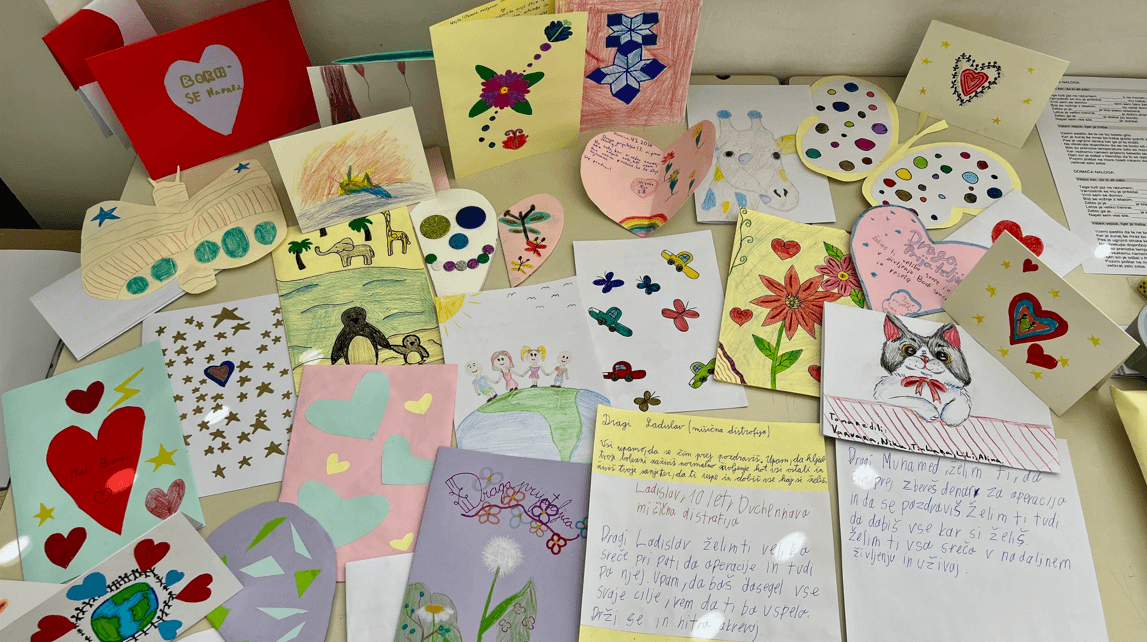
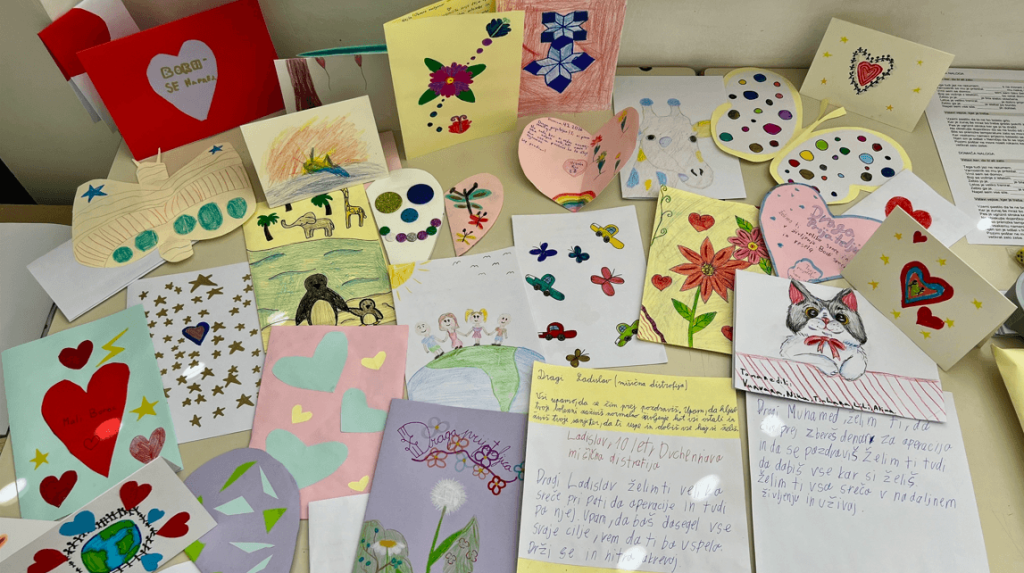
We have joined the "Heartfelt Letters for Little Fighters" project. Pupils have prepared letters of support for children with rare diseases, thereby expressing solidarity and compassion for others.
URA
VEHICLE 1. We talk to the pupils about the value (5-10 minutes).
We ask students questions such as: »What is mutual aid?« and »How and when
«Can we help each other?" The pupils list examples of when they have helped someone themselves or when someone else has helped them.
When conducting a conversation, you can help yourself with the text:
Mutual aid is a value that allows society to function as a cohesive whole. It is like an invisible thread that binds us together. When I help you, I strengthen our relationship. When you help me, we build a shared future. Mutual aid is not just about giving, but also about the ability to accept help with dignity. Mutual aid is the foundation of human solidarity and can significantly contribute to a fairer and more compassionate community.
URA
VEHICLE 1. Heartfelt letters for little fighters on World Rare Disease Day (28 February 2026)
We can also offer mutual assistance by remembering people who are facing difficult trials in life. These include children with rare diseases and their families. On World Rare Disease Day, our school is joining the nationwide project "Heartfelt Letters for Little Fighters". We discuss with the pupils what rare diseases are and why understanding the issue is important. The emphasis is on promoting the acceptance of diversity, empathy, and solidarity, and on raising awareness of rare diseases. We also highlight the exceptional importance of mutual support and let the little fighters know that they are not alone in what they are going through.
Rare diseases are mostly very serious health conditions. As many as 75 per cent of people who suffer from them are children. These diseases are mostly incurable, chronically progressive, cause disability, and are often fatal.
You can learn more about this topic by reading the stories of children with rare diseases, and you can also watch a touching video with your students, which is available on the website Viljem-julijan.si. We suggest you divide the students into groups, and then each group can write a letter. They can fashion this into a greeting card and decorate it as they wish. The students can write positive messages and wishes for children with rare diseases and their families. You can see some ideas and impressions from children and their families on the website Viljem-julijan.si/srcnapisma/.
APPLICATION
As part of the activities listed below, the seventh-grade students prepared a fun video, with the help of which they presented their school and class.
VEHICLE 1. We talk to the pupils about the value (5-10 minutes).
We ask pupils questions such as: »What does the word belonging mean and how do we express it?«, »Why is belonging important for an individual and why for society?«, »What are the dangers of excessive belonging?« You can use the text to help with the discussion.
Belonging is a feeling of duty or commitment to a person, idea, project, or community. Humans are social beings, so complete freedom, disregarding the community, does not exist, and cooperation is impossible without belonging to a common goal. To maintain one's identity, upbringing in one's mother tongue and heritage is particularly important, while at the same time, one should constantly learn about and from others. Unconditional belonging, which does not include respect for others, can quickly turn into a negative value – hostility. Belonging must not end at the community's border but must remain universal, common to all humanity.
Workshops: The planned workshops are intended to be completed in two hours, so you should decide for yourselves when to conduct the first and when the second of these hours, based on the needs and abilities of your class. The individual activities are adapted to the age of the pupils.
VAJA 2. Family coat of arms
»The family is the key to happiness.«
We acquire and develop a fundamental sense of belonging in the family. This is where values, rituals, and celebrations are formed. People come to the family, bringing gifts. The family lives in a specific building, in a certain environment, and engages in certain activities. All of this shapes the identity of family members. Objective: Children become aware of some elements that define their family and express this graphically.
The purpose ofChildren become aware of certain elements that define their family, which
expressed in graphic form.
Flow:
- The teacher prompts the pupils to reflect on what is characteristic of their family, what family customs and celebrations they have, and what they do together. Furthermore, they consider if they engage in any special family activity (craft, business, farm, etc.) and if any person from the past has particularly influenced them.
- The teacher prepares sheets with the outline of a coat of arms, and above it the inscription "My Family".
- Explain the concept of a coat of arms to the pupils and discuss with them what a coat of arms represents and what kinds of coats of arms we know. Present them with the Slovenian and municipal coat of arms and explain what they depict.
- Invite pupils to design a family crest. They have various pens and coloured pencils available. The crest can be made up of several parts, or they can create a single image that represents some of these elements:
- Popular family activities
- things that connect them
- Family tradition
- End of residence
- important predecessors
- activities that the family engages in
Each child briefly introduces his or her family's coat of arms.
VAJA 3. Classroom Constitution (Years 5–9)
The purpose ofWe discover and strengthen class belonging, which we physically define in the form of a class constitution.
Flow:
- First, let's discuss the positive qualities of individual pupils. Classmates and teachers identify one or two key qualities for each pupil.
- How would you describe our class? Let's prepare cards with different inscriptions, such as:
- sporty
- Pevski
- curious
- agreement
- creative
- ready to help
- friendly
- Wishes
- Ugly
- Let's sort the cards by classroom floor. The pupils look at them and choose two that best describe their class. Each pupil gets two coloured stickers, which they stick onto the chosen cards. They can also express their opinion by drawing a cross or a dash on each card with a marker. The two or three descriptions that receive the most votes from the pupils will be included in the class constitution.
- When we ask pupils what kind of class they would like. We are looking for class values. We prepare a set of values that we offer them if they do not come up with any themselves (you can focus on five core values):
- friendly
- ready to help
- resourceful
- open and welcoming to new people
- trustworthy
- respectful
- fun
- viewed
- persistent
- workroom
In class, we agree to select a maximum of five values that we will follow this academic year.
- We will create a poster listing the positive qualities of students, with a maximum of three descriptions of our class and a maximum of five values that we will follow.
- The pupils, based on all the information gathered, think about what a class coat of arms would look like. One or two more artistically gifted pupils depict it on a poster.
- A vision poster on the classroom wall. We stop by it when something goes wrong in class. Then we remember the class values and definitions, which can guide our actions. When we need to do something, the set of positive qualities of individual students can help us.
SERIOUSNESS
The activities related to this theme are primarily focused on reflecting on the importance of a healthy and clean environment, and on the moderate and responsible use of technology in everyday life.
URA
VEHICLE 1. We will have a discussion with the students about value (5–10 min).
Pupils are asked questions such as: »What does the word moderation mean?«, »How do we know if we have made the right choice in a given situation?«, »Can you recall an event when there was a real lack of moderation?«, »In what ways did this manifest itself?«, »What were the consequences?«. You can use the text to help guide the discussion.
Moderation is a value that guides us to balance between opposites (between belonging and freedom, tradition and innovation, giving and receiving) and teaches us to live thoughtfully, respectully and sustainably. Although in its exaggerated form it can lead to passivity or indecision, it remains key to harmony between the individual, society and nature, as it protects us from extremes, exhaustion and division. It is the art of wise regulation, where moderate steps are valued in a world of constant excess.
VAJA 2. Clean-up drive – let's clean up the area around the school
We are constantly seeking ways to maintain natural balance and prevent the depletion of natural resources. Moderation encourages us to reflect on sustainable development, whereby the needs of present generations are met in a way that does not compromise the opportunities available to future generations. Moderation means respecting nature and acting responsibly with its resources, as only in this way can we ensure the long-term preservation of our planet.
Today's lesson will focus on the nature around our school. We will try to
to take better care of her. Together we will clean the surroundings and remove the waste.
URA
VEHICLE 1. Using Digital Devices – DIGITAL COMPASS
TargetTo understand moderation through the analogy of food/fun and to recognise the pitfalls of mobimania.
InstructionsThe workshop can be carried out with the help of the "My Digital Compass" worksheet (attached), which you can halve and cut, or you can do without it.
1. Introduction: What is moderation? (10 minutes)
- Question for studentsWhat would happen if you ate half a kilogram of chocolate every day for lunch?»
- Expected answersWeakness, abdominal pain, long-term illness.
- Key messageModeration means enjoying things in a way that doesn't harm us. It's not about prohibition, but about making wise choices.
- DiscussionIn what else is moderation needed? (sport, sweets, phone, computer games, etc.)
2. The Search for Truth: How Much is Too Much? (10 minutes)
- TaskPupils should write on a sticky note, without it being visible to others, approximately how many hours they used their phone last Saturday.
- Prompts for encouragement:
- »Do you have your phone in your bag, pocket, or locker during class?«
- »Do your parents ever tell you that you spend too much time on devices?«
- The teacher explainsResearch indicates that excessive screen time in children leads to problems with concentration and attention, as well as poorer sleep, learning outcomes and family relationships. In addition, difficulties with emotional regulation may also occur.
3. Video viewing and analysis (15 minutes)
- Video: Safe.si: Mobimanija
- Questions we ask after watching the video:
- »What happened to the sheep when they got phones?« (They became absent, they no longer socialised with each other.)
- »What does it mean to be addicted?«
- »Why is it hard to put down our phones once we start watching videos?« (The goal of algorithms is to keep us glued to our screens.)
4. Conclusion: The Blue Light and Sleep Rule (10 minutes)
- QuestionWhy do we need to put devices away at least 1.5 hours before sleep?»
- ExplanationPhones emit blue light, which tells the brain it's still daytime. Consequently, the secretion of melatonin (the sleep hormone) decreases. In addition, watching exciting content keeps us awake for longer.
- Challenge»Who promises to turn off their phone at 8 PM today and, instead of using it, read five pages of a book?«
VAJA 2. Using digital devices – Master of your own time
TargetCritical evaluation of the FOMO (Fear Of Missing Out) effect, taking responsibility for one's digital device usage habits, and striving for moderation in screen-based device use.
WarningFor the next activity, students will need a phone, so please inform them in advance.
InstructionsThe workshop can be carried out with the help of the Master of Your Time worksheet (attached), which you can halve or cut, but you can also do it without it.
1. Starting topic: moderation as freedom (5 minutes)
- Question»Are you in control of your phone, or is your phone in control of you?«
- DiscussionIs moderation still a modern value, or is it just for older people?
- DefinitionModeration in the digital world; having control over when you enter and when you exit.
2. Self-reflection: Screen Time (10 minutes) – each student needs their own phone to complete this activity
- Active taskPupils open the settings on their phone (Screen Time or Digital Wellbeing).
- AnalysisThey check the data for yesterday and for last Sunday.
- Questions:
- »Which app takes up the most of your time?«
- »How many times a day do you unlock your phone?« (The number will likely shock them.)
- »Do you have a phone usage time limit set?«
3. Video in psychology (15 minutes)
- VideosDon't let Fear Of Missing Out (FOMO) get to you, and by extension, the internet's reputation.
- Discussion questions:
- »What is FOMO (Fear of Missing Out)? (The fear that we will miss out on something important if we are not up to date with the latest news).
- »On a scale of 0 (I couldn't care less, it doesn't bother me at all) to 10 (I'm sweating, my hands are shaking, my stomach is churning, I'm completely panicked), how anxious do you feel if you don't have your phone with you? Why do we feel anxious if we don't have our phone with us?«
- »How does constantly checking notifications affect our ability to learn?« (After every interruption to learning that is not related to the subject matter, we need 10–15 minutes to be able to refocus on deep thinking and learning.)
4. Plan for a digital detox (15 minutes)
- Scientific backgroundExplain to learners the effect of blue light on the sleep-wake cycle (blue light keeps us awake as it suppresses the secretion of melatonin – the sleep hormone) and the effect of dopamine (short-lived pleasure that occurs when we receive a 'like'), which can lead to moderate addiction, particularly affecting young people up to 24 years of age, as the frontal cortex, the brain's executive centre, is developing during this period.
- A task carried out in groups.Identify three rules of moderation that all your classmates should follow.
- Examples: After 8 PM and while studying, my phone is in another room. I don't look at screens during meals.
- Concluding thoughtTurn it off – sometimes the best thing you can do to improve concentration is to simply switch off.
The following may be helpful when you are leading a conversation:
- Be an example. Tell them that adults also face challenges when it comes to moderation.
- Without judgmentIt's not about preaching, but about raising awareness. The goal is for the student to realise themselves that six hours spent on TikTok on a Sunday might indeed be too much.
- Expected answersPupils will likely say they need a phone to set their alarm clock. Suggest they use a traditional alarm clock. They might say that a phone allows them to stay in touch with friends so they can do homework together. Encourage them to opt for a phone call instead of three hours of texting.
- Use humourWhile listening to internet rap, they might laugh, but the lyrics hit home. Perhaps you could encourage them to analyse the verses.
Advice for teachers when using worksheets:
- ComparisonEncourage them to compare the time they spend on their phones during the week and at the weekend. The difference is often huge, which can be a great starting point for a discussion about what they do when they have too much free time.
Primary School FLV Slivnica
 English (UK)
  Slovenščina
  Italiano
  Magyar