

If you didn't get rid of it in time, it was up to your knees. If you left it too long, it was up to your waist. And then you didn't go out anymore, but stayed at home. It got harder every year with Lojzka.
She was old; around eighty years of age. Small and hunched in on herself, as if wanting to be as inconspicuous as possible. Always the same headscarf, the same coat. Her house reflected a silence you could feel even before entering. She had lost her husband long ago. He had been a butcher. They said she was still young then. Then she was left alone. No children, no real company, just days following one after another, and the snow returning every year.
This winter, there was too much of it. It didn't look like it would stop snowing any time soon. It just kept piling up layer upon layer. The road was barely passable, and you could hardly see the entrance to her house. The door was half-buried, and the steps and the yard were no longer recognisable. And it was said that the community nurse, who came for her health, couldn't reach her, even though Lojzka desperately needed her.
Srečko Pristovnik said that he hadn't thought about it at all. He just put on his shoes, grabbed a shovel, and left. Milan Zavasnik did the same. Mum's uncle Srečko was the lady of the house's neighbour. They hadn't coordinated or called each other. When they arrived at the house, they saw they weren't the only ones. Others were already there: some lads, an older neighbour, and children who had oversized gloves and shovels that were almost bigger than them. They didn't know how to shovel, but they wanted to be there. Nobody asked what anyone was going to do, they just started.
The snow wasn't light; it was heavy and wet. The kind that sticks to the shovel and won't let go. You had to cut it, lift it, and push it away. Slowly and with effort. In between, you'd stop and catch your breath, then continue. There wasn't much talking, just short sentences, spoken almost between breaths. Milan, as always, worked quietly. Srečko said something now and then – more to break the silence.
Lojzka only opened the door after a little while, as if she couldn't believe they were really there. She stood on the threshold, so small against all the snow.
»What are you doing?« she asked.
»Pot,« someone replied.
And that was all.
»It shouldn't be then,« she said.
At that moment, Milan paused for a moment, looked at her and said, »If you hadn't arrived, you would have been buried.« And he walked on.
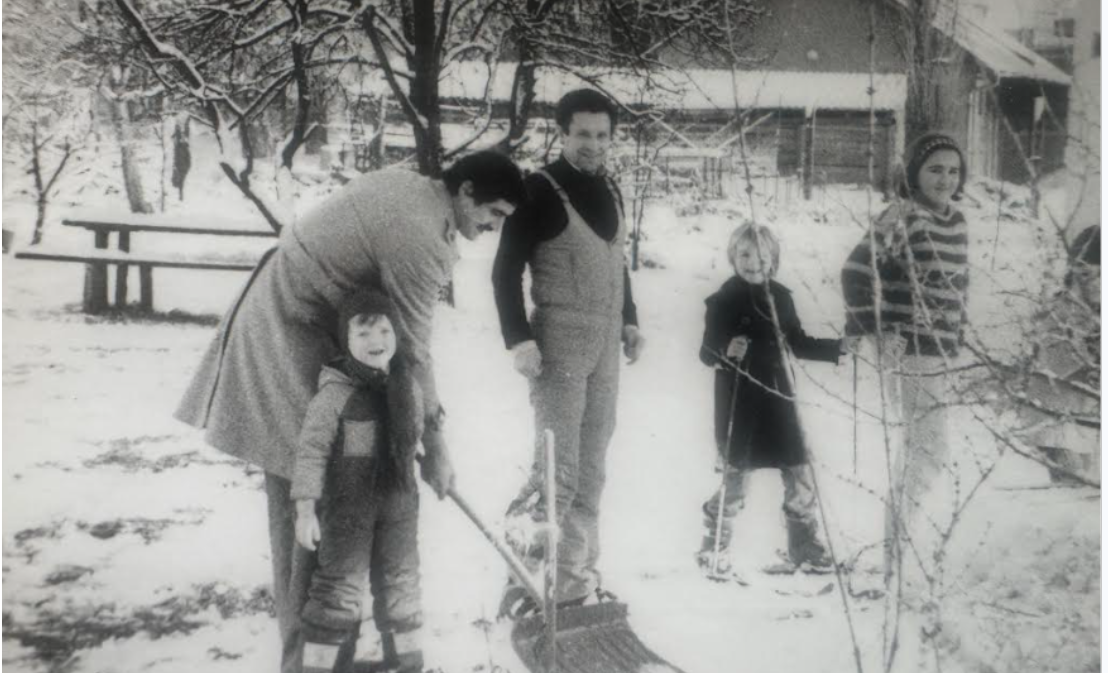
The path slowly began to appear. First narrow, then wider; to the door, to the road, around the house, to the firewood. In between, the children fell into the snow and got up from it, laughing. In one photograph taken that day, Srečko, Milan, the children, and others stand together. No one stands out. They are just the people who were there.
When they had finished, they left without a word and without the feeling that they had done anything special. The next day, the district nurse came. And Lojzka was no longer trapped.
Srečko later said something that remained deeply in memory. That they didn't go because they were good people, but because they would have been ashamed to sit at home, knowing she was there alone. And perhaps that is the hardest part of this story. Not that they helped, but that they admitted that their own silence and leaving the little wife to the mercy of the situation would hurt them more than the cold outside.
Zala Krupljan, 3 March 2026
 English (UK)
  Slovenščina
  Italiano
  Magyar