

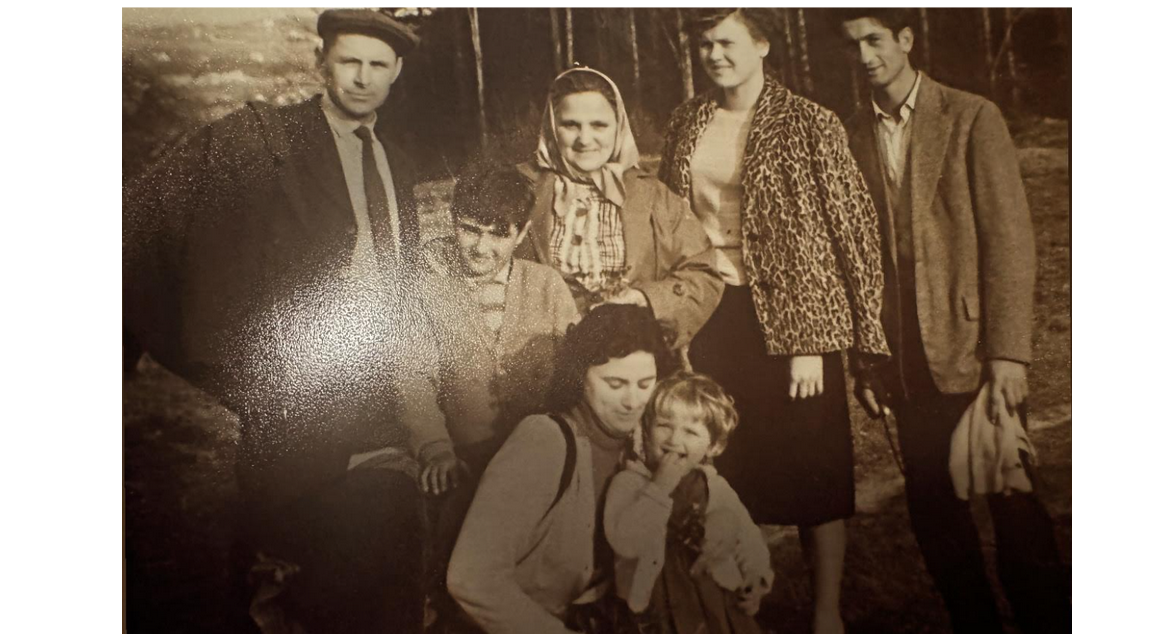
The shadow of the beech trees falls across their faces... My grandfather is standing right on the edge of the picture, looking away with one eye, as if he didn't want to be photographed, but they caught him anyway. Next to him is my grandmother; sleeves rolled down, a seriousness on her face that you only know if you've ever buttered bread for nine people and made sure the milk didn't escapes from a sportsnet. My mother, aged three, is in her dress, with her ally, her godmother Ivana, whom we all called Jenda, and her family.
That was not a special occasion. It was a hot Sunday, the kind of Sunday that can only happen here in summer. After lunch they went to the meadow to take a photo for the album. There were no telephones then, just one boxy camera that needed a minute of silence. And in that minute, everything was made.
My grandfather was Croatian. He was born in Garešnica, where the storms are fiercer and the people louder than here. He came to Slovenia young and in love. In love first with my grandmother, and then slowly - and perhaps even more deeply - with our land. He never forced himself, he never wanted to pretend, but step by step he began to belong.
He spoke Slovenian with a soft accent. He was not embarrassed when he said spoon with a long i. He didn't mind when someone corrected him on this. He always just laughed and said, "I will. Just so you understand me." And we did. Better than I would have thought.
He loved our forests. He carried mushrooms home with a certain reverent care, as if they were treasure. He always said: 'This land has welcomed me. Now I am hers." And that was not a phrase. He planted potatoes on the same day every year because that's how Slovenians do it. He sang Slovenian songs, even though they were foreign to him, and never said yours homeland, but always our.
Babi didn't talk much about her homeland. For her, it was a way of life. To respect bread. To sit down to Sunday lunch, even if you were alone. To be able to listen to the wind and greet old people in the street. She was a woman of great words and deeds, and even when she touched the earth with her hands, you felt she knew where she belonged.
My mother grew up in Yugoslavia. In school, they were taught about unity, and at home they built values. Slovenia was hidden between the lines of fairy tales, in my grandmother's prayers and in my grandfather's pride whenever someone told him that he was fine Sloven. My mother was a girl between two worlds - the official one and the one you feel in your bones.
Today, when I look at this photo, it is not only the family I see. I see a mix of cultures, languages and choices. A grandfather who chose Slovenia - not because he had to, but because he wanted to. Because he saw it as home. A grandmother who taught you how to bake a cake and how to be silent when you are in pain. And my mother, who wove it into something she gave me - a quiet, stubborn love for her homeland.
That's why when someone asks me why I care, I say, "Because my grandfather chose this land as his own. Because my grandmother never (really) left it. And because my mother, through it all, was able to keep what is most important - belonging to your homeland in your heart, no matter where life takes you."
And because this earth - though it will never be perfect - is ours.
Zala Krupljan, 10. 7. 2025
 English (UK)
  Slovenščina
  Italiano
  Magyar