

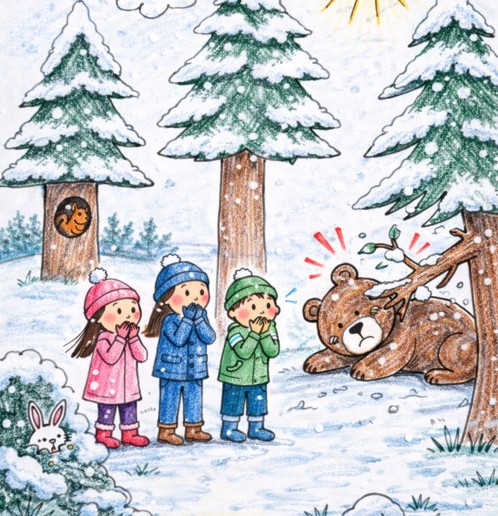
1. Activity title: A bear asking for help
2. Target group
- Pupils in years 1-5 of primary school (adaptable for pre-school).
- Estimated duration: 1 to 2 school hours
3. Form of work
Classroom work, individual work, group activity, discussion
4. Didactic starting points
The activity is based on understanding mutual aid as a fundamental mechanism for functioning in any community – family, class, etc. The trapped bear represents a problem or a moment of vulnerability that everyone finds themselves in at some point. Mutual aid means not leaving someone in distress alone, and joining forces to find a solution together.
5. Learning objectives
- To understand that we solve problems more easily with combined strength.
- to ascertain that each individual in the group has an important role,
- developing empathy,
- to strengthen the awareness that we are not alone when things get tough
- to experience a sense of safety and belonging in a group
- What cooperation
6. Accessories
- poster
- flomaster
- leaves
- Glue
7. Course of Activities
The teacher reads the seventh page and leads a discussion about what was read.
Interview questions
- Have you ever found yourself in trouble? What did you do?
- What do you do when you see someone in trouble?
8. Art activity: Free the bear
Objective To think about how we can help when someone is in trouble and to visually represent the help offered.
Flow:
- We draw a bear in trouble on the poster.
- Each pupil writes/draws an act of kindness on a slip of paper (I help, I lend, I encourage, I listen...).
- Let's stick the labels around the bear and talk about acts of mutual aid (when they did them, when they needed them...).
- Option: instead of solving the bear's problem, each student can create a drawing or comic strip about mutual assistance.
9. Movement activity: Let's carry a friend
Objective Seek cooperation, help, and understanding, so that together we are stronger and every link is important.
Accessories:
- Blanket/sheet
Flow:
- We spread a rug or sheet on the floor.
- One of the children lies down on it.
- The other children gather around the blanket/sheet and lift it.
- Students are moved to another agreed-upon place by holding a sheet.
- Options: Pupils can be divided into several groups. More activities can be added, e.g. in pairs/small groups they have to transfer a ball to the other end of the room/agreed location, without using their hands, or they can lie down on the floor, close to each other, with one pupil lying across them. By rolling, they move the pupil on top forward. When this pupil reaches the end, they lie down next to the others, and the last pupil lies across the rest ...
10. Conclusion and reflection
Final thought: »When we help each other, no one falls or is left alone.«
Let's discuss what would happen if one of the students dropped the blanket they were holding, why it is important to cooperate and help each other. Students can think of and present an example of their own, how they felt when they needed help and also how they felt when they helped someone who needed them. Together, they can create a plan for mutual assistance in the classroom.
Primary School Piran
 English (UK)
  Slovenščina
  Italiano
  Magyar