

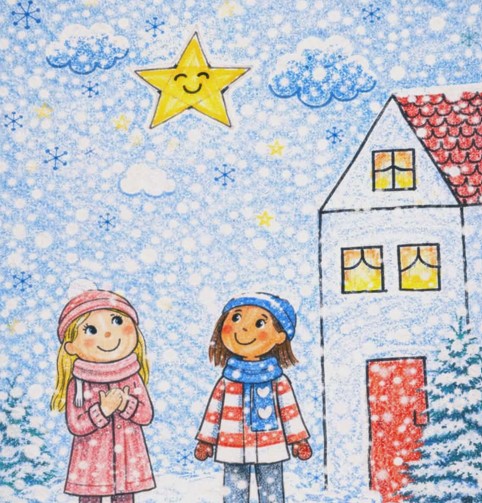
1. Activity title: My Little Star – Internal Guide
2. Target group
- Pupils from years 1-5 of primary school (adaptation possible for preschool age).
- Estimated duration: 1 to 2 school hours
3. Form of work
Whole class work, individual work, group activity, paired work.
4. Didactic starting points
The activity is based on a symbolic narrative about the transformation of light into the character of a little star, representing the inner guide (internalised values). It allows children to identify with, project emotions onto, and reflect on values.
5. Learning objectives
- developing imagination
- recognising the inner guide
- understanding the importance of leadership and trust
- the awareness that everyone can be a guide to themselves and others
- Reflecting on personal qualities that bring light
6. Accessories
- gold cardboard
- scissors
- Glue
- Felt tip pens, coloured pencils
- glitter or silver paper as desired
7. Course of Activities
The teacher reads the second page and leads a discussion.
Interview questions
- Ako bi me Zvezdica pozvala, da joj pomognem ponovno otkriti čaroliju vrijednosti, odgovorila bih joj ovako: "Draga Zvezdice, spremna sam. Vrijednosti su poput zvijezda vodilja na našem životnom putu. Nisu uvijek vidljive, ali njihov sjaj nikada ne nestaje. Pomoći ću ti da ih ponovno pronađeš tako što ćemo zajedno promatrati zvijezde, pričati priče o hrabrosti, dobroti i poštenju, te tražiti primjere tih vrijednosti u svakodnevici. Zajedno ćemo osvijetliti put ka ljepšem i smislenijem životu." Kako bih joj pomogla: * **Razgovarali bismo:** Ohrabrivala bih je da priča o svojim osjećajima, mislima i onome što joj je važno. Postavljala bih pitanja koja bi je potaknula na razmišljanje o vlastitim principima. * **Čitali bismo i pričali priče:** Knjige, bajke i stvarne priče koje ističu pozitivne ljudske osobine mogu biti snažna inspiracija. Odabrali bismo priče o herojima, dobročiniteljima i ljudima koji su se vodili višim ciljevima. * **Promatrali bismo prirodu:** Priroda je puna lekcija o strpljenju, rastu, recikliranju i ravnoteži – sve te su vrijednosti primjenjive u ljudskom životu. Zajedničko promatranje zvijezda, cvijeća ili šume može biti meditativno i fokusirati nas na ono bitno. * **Tražili bismo primjere u svakodnevici:** Pomogla bih joj da uoči male, svakodnevne geste dobrote, poštenja, suosjećanja ili marljivosti kod sebe i drugih. Čak i najmanji čin može odražavati veliku vrijednost. * **Igrali bismo se:** Kroz igre uloga, društvene igre ili kreativne aktivnosti možemo učiti i vježbati pozitivno ponašanje i empatiju. * **Postavili bismo male ciljeve:** Zajedno bismo definirali male, ostvarive ciljeve koji su usklađeni s vrijednostima koje želimo njegovati (npr. biti strpljiviji sat vremena, pomoći nekome bez očekivanja nagrade). * **Stvorili bismo "vrijednosni dnevnik" ili "zvjezdani podsjetnik":** Zapisivali bismo ili crtali stvari koje nas podsjećaju na važne vrijednosti, što bi joj služilo kao mantra ili vizualna pomoć. Moj cilj bi bio da Zvezdici pokažem da čarolija vrijednosti nije nešto dalekosežno ili komplicirano, već da je prisutna u nama i oko nas, te da je njeno njegovanje proces koji donosi duboko zadovoljstvo i smisao.
- If Star could only speak to us, what would it tell us about the values in our classroom?
8. Art Activity: My Little Star
Objective Visually depict the little star, your inner guide.
Flow:
- Every child cuts out a star.
- They draw her eyes, expression, the details that make their star uniquely theirs.
- Inside the star, they write/draw one characteristic they wish to develop, or a word that represents light to them.
- Option: Create a »class sky« – we attach all the stars to a blue poster to guide us towards better decisions and remind us of the characteristic/word we've written.
9. Physical activity: Light guide
Objective Experiencing the meaning of leadership and trust (responsibility and trust).
Flow:
- We are shaping coins.
- And one child closes their eyes (or, if they are uncomfortable, looks at the floor), the other is »Star«.
- The little star guides a classmate around the space – with a calm voice, simple instructions, without pushing. They must ensure the one who is blindfolded doesn't bump into anything, trip, etc.
- After 1–2 minutes (or at the teacher's discretion), roles are swapped.
- Option: we can add more vases to strengthen trust.
10. Conclusion and reflection
Concluding thought: “To each other, we can be a light.”
The teacher leads a discussion about what it was like to be led and what it was like to lead/be a leader. What is needed to be a good leader (leading the conversation to responsibility and trust)? We highlight that we must be responsible when someone trusts us.
Primary School Piran
1. Activity title: Magic is not fantasy
2. Target group
- Pupils in years 1–5 of primary school (adaptable for preschool)
- Estimated duration: 1 to 2 school hours
3. Form of work
Frontal work, individual work, group activity, discussion.
4. Didactic starting points
The activity is based on a symbolic narrative about »magic«, which represents five core values: trust and respect, honesty, mutual support, belonging, and moderation. It allows children to understand the impact of behaviour on the group. The fundamental concept is that values do not exist or not in themselves, but rather they must be applied.
5. Learning objectives
- recognise behaviours that enhance or diminish well-being
- to understand the effect of one's own actions on others
- recognise the power of positive behaviour
- to distinguish behaviours that »turn on« or »turn off« a group
6. Accessories
- sheet of paper, split in half
- Coloured pencils
- flomasters (optional other material for other techniques)
7. Course of Activities
The teacher reads the second page and leads a discussion (the second page has two possible preparations – both can be done or one can be chosen).
Interview questions
- In which world would you prefer to live – a cold and sad one or a warm and happy one?
- Who decides what kind of world we have?
8. Art activity: On-Off
Objective Visually depict the difference between positive and negative behaviours.
Flow:
- We divide the page in half with a vertical line.
- The left side represents the world when we »switch it off«. (We ask: What happens when no one listens? When we all shout? When we mock someone? When we don't help each other and don't cooperate? ... (We adapt the questions to potential issues in the classroom.))
- Next is drawing – on this half we draw with dark colours, sad faces, unfortunate people, mess…
- The right side represents the world when we »turn it on«. (We ask: What happens when we help each other? When we use nice and kind words? When we wait our turn? When we cooperate?...)
- Next is drawing – on this half we draw with bright colours, smiles, happy people, the sun
- A topic for discussion: Which world is more beautiful and why? Where is life better? Who is it that can “turn off or on” a more beautiful world? ...
9. Motor activity: Switch on and off
Objective To feel the effect of behaviour physically.
Flow:
- The children move around the space (they can run, walk, dance, jump, etc. – we adapt to the space and needs).
- The teacher describes the behaviour (positive or negative).
- If the described behaviour is positive, the children stand up straight, spread their arms wide and smile broadly.
- If the described behaviour is negative, children squat, avert their gaze, and become small.
Examples of behaviours:
I am helping a classmate.
I push others when I wait in the queue.
I say thank you.
I make fun of or tease classmates.
I am waiting patiently in line...
● Upgrade option: Children invent their own examples of behaviour and they give instructions or invent their own movements.
10. Conclusion and reflection
Final thought: »With our actions, we can ignite a better world."
Pupils contemplate what kind of world is nicer to live in and share their feelings about both activities through a guided conversation. The conversation leads to the understanding that our actions influence the world around us – the understanding that we are not passive observers, but active co-creators.
Primary School Piran
 English (UK)
  Slovenščina
  Italiano
  Magyar